
Spiral Heat Exchanger Type 1
Self-cleaning by design — built for fouling-prone and viscous fluids that clog conventional exchangers.
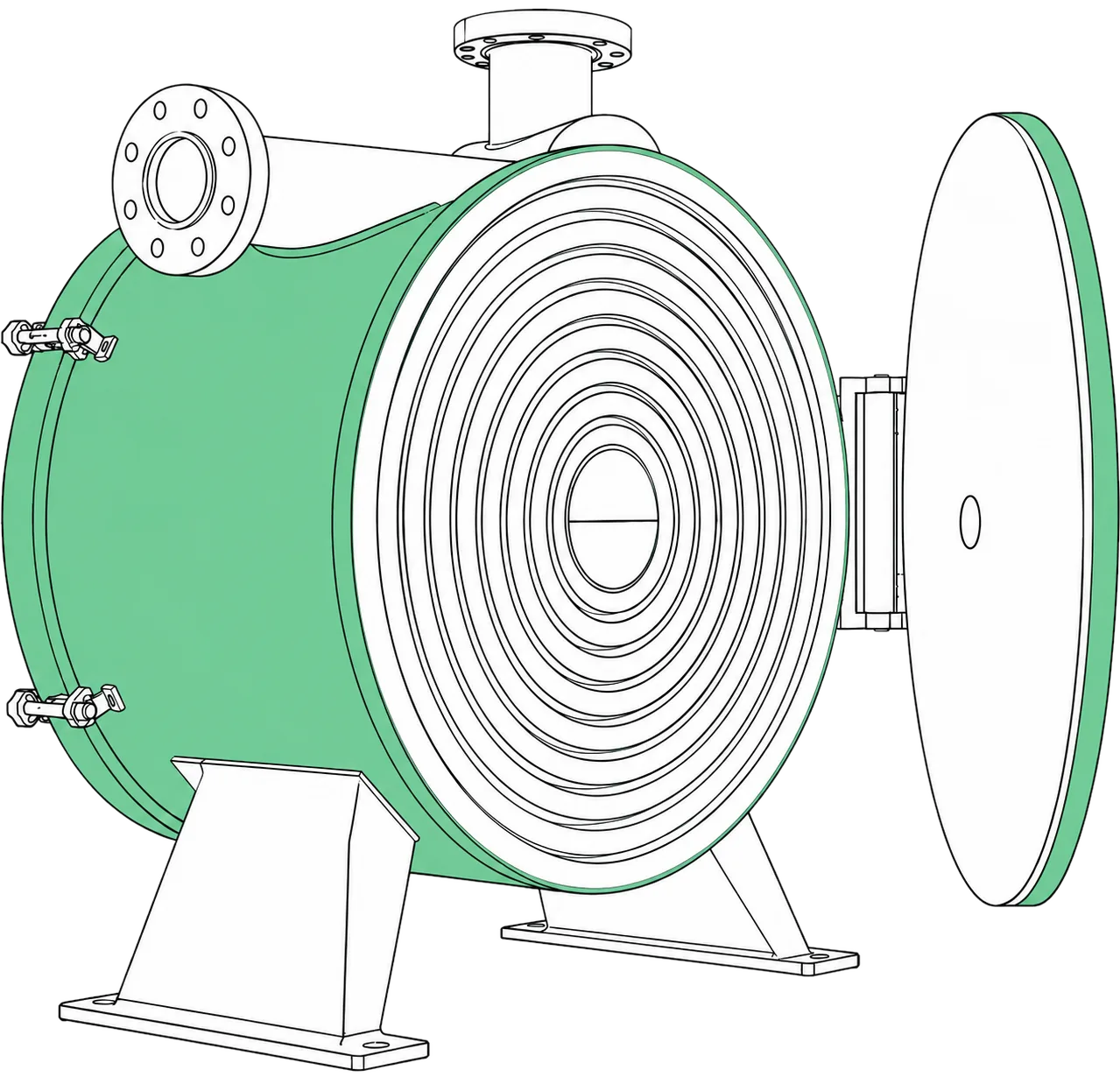
Spiral Heat Exchangers use a single continuous flow channel wound into a compact spiral — a geometry that’s inherently self-cleaning, since the constant curvature generates centrifugal scrubbing action that keeps the channel clear. That makes Type 1 the natural choice for fouling-prone, viscous, or high-solids-content fluids that would quickly clog a conventional plate or tube unit — slurries, sludges, and process streams with suspended solids that other exchanger types struggle to handle without frequent cleaning shutdowns.
Because the flow path is a single channel rather than multiple parallel passages, there’s no risk of flow maldistribution — every bit of fluid takes the same path, which keeps performance predictable even as the fluid’s condition varies. Our engineers design around that same principle: characterizing your fluid’s actual fouling mechanism and sizing for realistic long-term performance, not clean-condition theoretical output.
This is one of the areas where hands-on experience matters most — a spiral unit sized correctly on paper can still underperform if the fluid’s actual fouling behavior wasn’t properly characterized upfront. We draw on the same spiral-flow fundamentals behind our software, with the field judgment to confirm the geometry will actually deliver the self-cleaning action the fluid needs before committing to a design.
For particularly difficult fluids, we sometimes recommend a pilot-scale trial or a site visit to characterize actual fouling behavior before finalizing a design — a step that costs a little upfront time but avoids a far more expensive redesign after a full-scale unit underperforms.